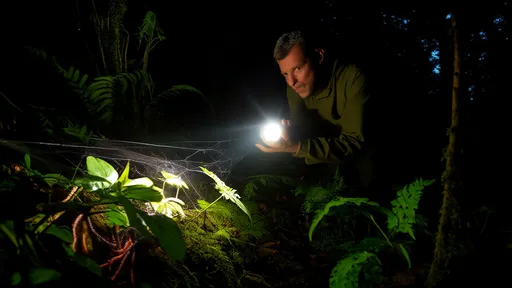
The Amazon rainforest comes alive at night in ways few daytime visitors ever witness. As darkness blankets the canopy, a hidden world of creatures emerges - their presence often betrayed only by the eerie glow of eyes reflecting torchlight. For researchers, guides, and intrepid explorers, understanding these ocular signatures can mean the difference between spotting a curious ocelot and stumbling upon a defensive caiman.
The Language of Eyes in Darkness
When your flashlight beam cuts through the inky blackness of the Amazon, the color and shape of returning eyeshine tells a vivid story. This phenomenon, caused by the tapetum lucidum - a reflective layer behind the retina - varies dramatically between species. The variations didn't evolve for human observers, of course. These ocular mirrors give animals superior night vision by bouncing photons back through their retinas a second time. But for those who know how to interpret them, these glowing orbs become identification beacons in the night.
Mammals tend toward cooler color spectrums. The large, round eyes of jaguars shine an unmistakable emerald green, while their smaller feline cousins, ocelots and margays, reflect a slightly yellower chartreuse. Tapirs' eyes glow blue-white, often appearing first as floating orbs at about knee-height before the rest of their barrel-shaped bodies materialize from the undergrowth. The haunting red eyeshine of the giant Amazon river otter can startle night canoeists - their paired rubies seeming to hover just above the water's surface before vanishing with a splash.
Cold Blooded Clues
Reptilian eyes tell different tales. Caimans and crocodiles display an ominous ruby red that seems to intensify when the animal is agitated. Their eyes sit higher on the head than mammals', creating a distinctive "headlight" effect when floating in waterways. An experienced guide can estimate size by how far apart the glowing points appear. Frogs and toads often show up as sudden bursts of gold or green, their eyes proportionally larger than mammals' relative to body size. The paradoxical frog's enormous eyes glow an almost metallic silver, resembling tiny mercury droplets in the leaf litter.
Perhaps most mesmerizing are the arachnids. Tarantulas' eyes don't reflect light in the dramatic fashion of vertebrates, but wolf spiders' eyeshine appears as twin pinpricks of sapphire blue when caught at the right angle. The sheer number of these azure sparks across the forest floor on humid nights reveals an otherwise invisible population density that would unsettle most urban dwellers.
Avian Oddities
Birds present fascinating exceptions. Most diurnal species show little to no eyeshine, but nocturnal hunters like potoos and owls demonstrate why they rule the night skies. A common potoo's enormous eyes glow an unearthly orange-yellow, often the first indication of what initially appears to be a broken tree branch suddenly having a face. Owls' eyes can range from golden to deep red depending on species, with the spectral colors appearing almost detached from their bodies when viewed head-on.
Nightjars, those masters of camouflage, betray their presence through ruby-red ocular reflections that seem to float above trails like malevolent spirits until the bird takes flight, its wings suddenly filling your light beam with swirling shadows. Guides often joke that seeing these without warning has caused more dropped flashlights than any actual threat in the jungle.
Interpreting Behavior Through Eyeshine
The dynamics of these glowing orbs reveal more than just species identification. The direction and movement of eyeshine provides critical behavioral cues. Two closely-spaced green dots moving steadily parallel to the ground likely indicate a jaguarundi on the prowl, while erratic bouncing green sparks suggest the acrobatic hunting of a margay. Stationary red eyes at water level demand caution - a basking caiman may ignore passing boats, but a hunting individual will often submerge as approached, its eyes disappearing last.
Height matters too. Knee-level green could be an agouti or pacarana, while the same color at waist height might signal the much more dangerous bush dog. Experienced trackers learn to distinguish between the steady glow of a watching predator and the flickering reflections of prey animals that nervously turn their heads. Even the act of shining your light can provoke reactions - tapirs often freeze, their blue eyes widening, while capybaras typically bolt immediately, their reddish eyes vanishing in a streak.
Ethical Considerations
Modern researchers emphasize responsible light use during night surveys. The traditional practice of "spotlighting" has come under scrutiny as studies reveal how artificial light affects different species. Nocturnal hunters like ocelots may abandon hunts when illuminated, while some frog species temporarily cease calling. Current best practices recommend using red-filtered lights when possible, keeping beams diffuse rather than focused directly in animals' eyes, and limiting exposure time during behavioral observations.
The magic of Amazonian nights shouldn't come at the expense of its inhabitants. As one veteran researcher noted, "We're guests in their world, not spectators at a theater." The most rewarding encounters often come from patience - sitting quietly in one spot until the forest forgets your presence and its true nightlife emerges. When a tapir finally wanders into your dim red light, its calf in tow, or when a potoo begins its haunting call mere meters from your unnoticed position, you understand that the greatest privilege isn't seeing, but being allowed to witness.
The next time your flashlight catches that sudden gleam in the blackness, take a moment. Consider the creature behind the glow, the evolutionary marvel that is its vision system, and the fragile balance of the night ecosystem you're temporarily sharing. The colors tell stories written over millennia - we're just beginning to learn how to read them.

By /Jul 25, 2025

By /Jul 25, 2025

By /Jul 25, 2025

By /Jul 25, 2025

By /Jul 25, 2025

By /Jul 25, 2025

By /Jul 25, 2025
By /Jul 25, 2025

By /Jul 25, 2025

By /Jul 25, 2025

By /Jul 25, 2025

By /Jul 25, 2025

By /Jul 25, 2025

By /Jul 25, 2025

By /Jul 25, 2025

By /Jul 25, 2025

By /Jul 25, 2025

By /Jul 25, 2025

By /Jul 25, 2025

By /Jul 25, 2025